

Why Rote Memorisation Fails
Every Singaporean parent has likely witnessed it at some point: their child painstakingly writes out a Chinese character multiple times, aces the spelling test—or ting xie—only to forget that same word entirely by the following week. It feels disheartening, as if all that effort amounted to nothing. The problem isn’t your child’s ability or even their discipline. It lies in the method. Rote memorisation, as commonly practised, is inherently brittle. It relies on creating a single, shallow connection in the brain, one that easily fades unless constantly refreshed through repetition.
But what if there was a better way to help your child not only remember Chinese words more effectively, but also enjoy the process? Multisensory learning offers exactly that. This approach activates multiple parts of the brain simultaneously, building a richer and more durable network of associations. When your child sees a character, hears it spoken, acts it out, and connects it with something tactile, visual, or even edible, the brain doesn’t store that information in one place—it embeds it everywhere. The result is stronger recall, deeper understanding, and significantly more enjoyable learning.
Multisensory learning is not about turning Chinese lessons into chaotic play. It’s about being strategic with how different senses are activated, reinforcing vocabulary through real-world context, emotion, and creativity. This guide unpacks the science behind why it works and offers practical ways for you to apply it at home, even if your own Mandarin isn’t fluent.
The Science Behind Multisensory Learning
At its core, multisensory learning is about making the brain work harder—but in a good way. When children are taught using just one sensory pathway—say, visual recognition through flashcards—they are only using a narrow section of their cognitive resources. This might yield quick results in the short term, but it fails to create the kind of long-term memory that fluency requires.
Memory in the brain forms through neural connections. The more parts of the brain activated during learning, the more connections are formed. For example, when your child sees a word (activating the visual cortex), hears it spoken (auditory cortex), speaks it aloud (motor cortex), writes it out in sand or on a tactile surface (sensory and motor cortex), and experiences it through taste or smell (olfactory cortex), these multiple areas begin to wire together. The memory becomes not just a single point in the brain, but a web. That web is far less likely to break under stress, distraction, or disuse.
Neuroscience consistently shows that learners retain information better when multiple modalities are involved. This isn’t new-age theory; it’s a widely recognised principle in both early childhood education and second language acquisition. What’s often lacking, however, is guidance on how to apply these ideas specifically to learning Chinese—a language known for its complexity and visual richness.
Visual Engagement: Creating Mental Images with Every Word
In Chinese, the visual component is incredibly powerful. Characters themselves are not simply abstract symbols; many are made up of radicals that carry meaning and history. A child who memorises the character 休 as a static image might forget it within days. But explain that it combines a person (人) resting under a tree (木), and have your child draw that scene, and suddenly the character becomes a vivid, memorable story.
Using colours is another method that helps visual memory. Assigning specific colours to tones—say, red for first tone, green for second, blue for third, and purple for fourth—builds associations that extend beyond sound. When children write their vocabulary in colour, they’re absorbing tone patterns along with the words themselves.
Another powerful visual strategy is mind mapping. If your child is learning vocabulary about animals, drawing a spider diagram with pictures, Chinese characters, and pinyin labels helps anchor the relationships between words. These maps make abstract word lists feel like connected, visual ecosystems in the brain.
Auditory Engagement: Building Memory Through Rhythm and Sound
Sound is one of the strongest memory cues we possess. Just think of how easily song lyrics are remembered. Applying that to Chinese vocabulary is not only effective—it’s fun. Singing vocabulary through rhymes or melodies, using audio recordings of native speakers, or even playing pronunciation games can dramatically improve your child’s listening and speaking skills.
Even more subtle techniques can be helpful. Creating sound effects for certain words—such as mimicking an animal noise or emotional reaction—connects the word to a unique auditory memory. If “laugh” becomes tied to the act of laughing and hearing laughter, it is much more likely to be recalled spontaneously.
Daily exposure to Mandarin audio is crucial. Whether through Chinese cartoons, audiobooks, or family podcasts, passive listening builds familiarity with tone, cadence, and sentence structure. Over time, this ambient exposure develops your child’s ear for the language and builds comfort with its sound.
Kinesthetic Learning: Memory Through Movement
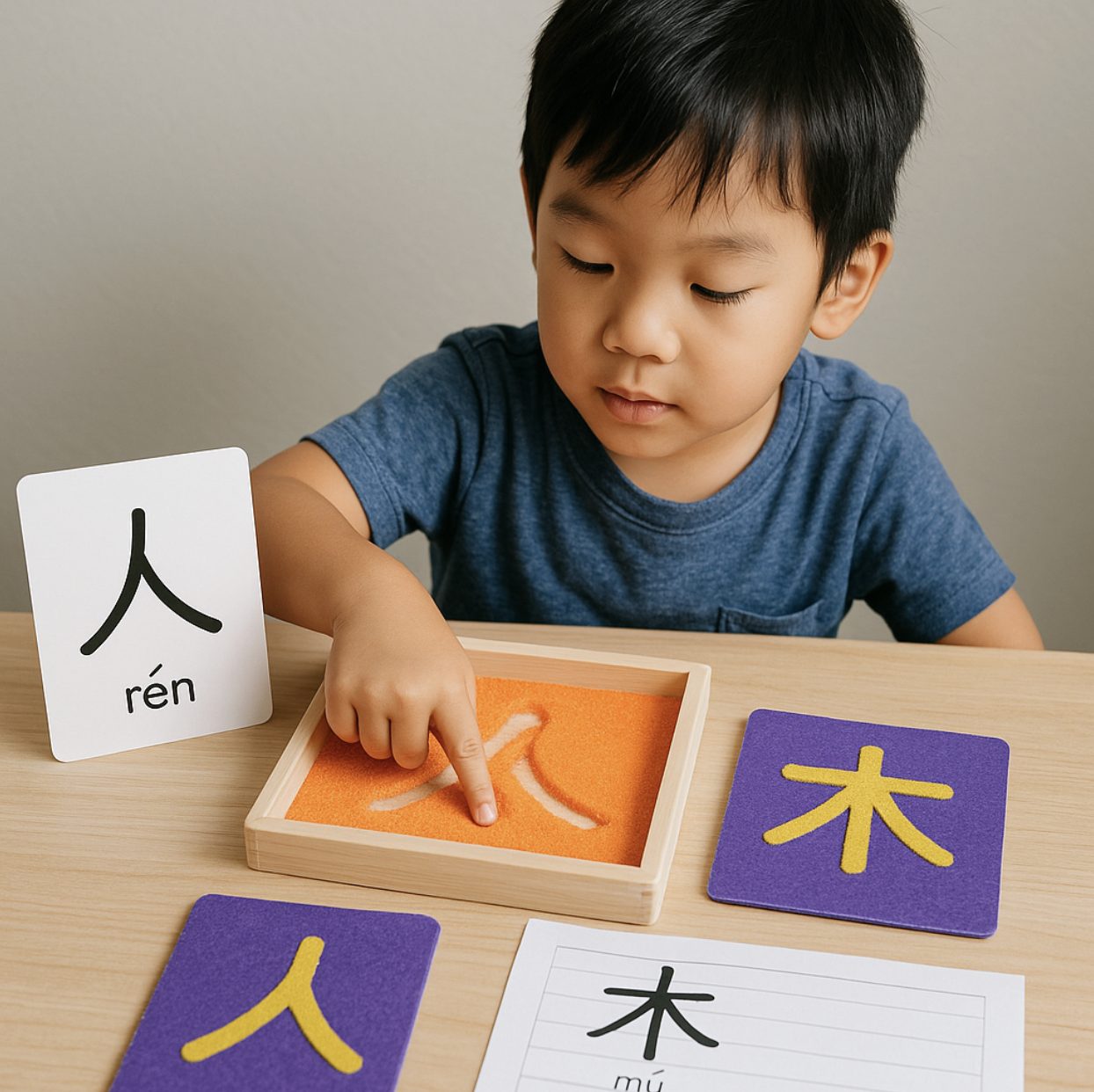
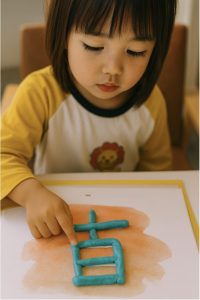
One of the most underused, yet highly effective, forms of vocabulary retention comes through physical activity. Writing characters in the air, tracing them on someone’s back, or using textured surfaces like sand trays or rice tubs turns memorisation into a tactile experience.
Movement can also be used to represent meaning. When learning action words or adjectives, turn the experience into a game. Ask your child to act out “run” (跑), “sleepy” (困), or “angry” (生气). These embodied experiences don’t just reinforce vocabulary—they make the language feel alive.
Tone gestures can also be introduced. For example, moving the hand horizontally for first tone, upwards for second, dipping for third, and sharply down for fourth reinforces tonal awareness in a physical and intuitive way. This muscle memory translates well to speech and helps reduce tonal errors.
Taste and Smell: The Missing Links in Vocabulary Learning
It may seem odd to suggest that taste and smell could be useful in learning Mandarin, but these senses can be surprisingly effective for certain kinds of vocabulary, especially food-related terms or descriptive adjectives.
The next time your child learns the word “sour” (酸), let them suck on a lemon slice. Learning “sweet” (甜)? Let them enjoy a piece of fruit or candy. Associating a taste directly with a word creates a visceral memory that’s much stronger than simply reading it from a book.
Smells can be even more subtle but equally powerful. Have your child smell a flower when learning “花”, or a cup of coffee when learning “咖啡”. These sensory experiences build emotional and physical associations that deepen recall in ways that visual or auditory memory alone cannot achieve.
Turning These Strategies Into Everyday Routines
Multisensory learning doesn’t require expensive equipment or elaborate lesson plans. What it does require is intention. Start small, with short five-minute sessions, and gradually build a sustainable routine that includes at least two sensory elements each time. For instance, reading a Chinese picture book together while using hand motions to act out the story, or listening to a podcast while drawing images to match new vocabulary. Over time, these small efforts compound, forming habits that make learning both more effective and more enjoyable. Remember, the key is not intensity, but regularity—and a calm, encouraging environment that allows your child to grow in confidence at their own pace.
Even everyday moments can become teaching tools. Cooking? Use food terms in Mandarin. Travelling? Point out road signs or directions in Chinese. Watching TV? Turn on Chinese subtitles or switch the audio. These small adjustments make the language feel more integrated into your child’s world, which is key for fluency.
Long-Term Benefits: Confidence, Retention, and Curiosity
Beyond short-term memorisation, multisensory learning offers broader cognitive benefits. Children who are exposed to language through multiple senses tend to develop more confidence in using it. They are less likely to be derailed by exam stress or forget key terms under pressure because their memories are reinforced in so many ways.
More importantly, multisensory strategies help instil a sense of curiosity and playfulness. When learning becomes an exploration rather than a chore, motivation increases. Children begin to view Chinese not as a subject to fear, but as a living language that connects with the real world around them.
Build a Better Memory Through Sensory Bridges
The traditional model of vocabulary learning—writing characters repeatedly on a page—still has value. But as a standalone strategy, it falls short. In contrast, multisensory learning builds strong, flexible bridges to long-term memory. It transforms a potentially dry, repetitive task into something engaging, effective, and deeply rewarding.
By combining visual, auditory, kinesthetic, and even olfactory or gustatory input, you equip your child with multiple access points to every word they learn. This method does not just increase recall; it builds confidence, fluency, and a deeper appreciation for the richness of the Chinese language.
Start small, be consistent, and treat every new word as an opportunity to experience language—not just memorise it. That’s how you build a memory palace, one delightful room at a time.