

Technology has revolutionised how we learn languages. The days of dusty textbooks, cassette tapes, and rigid night classes are long gone. Today, Chinese learners—whether they’re parents seeking the best program for their children or adult learners investing in personal growth—face a new challenge: choosing between two highly effective, yet fundamentally different models of learning. Should you go with a blended learning program that combines online and in-person classes, or opt for fully online learning that provides total flexibility and access?
Both approaches promise results. Both have helped learners across the globe make real progress. But Chinese is a language with unique challenges—tones, characters, and cultural nuance—that demand more than just convenience. To make an informed decision, you need to understand what each model offers, where they excel, and how they align with your personal or your child’s language goals. This guide breaks it down so you can choose the most effective path with confidence.
Defining the Models: What Are We Comparing?
Fully online learning refers to an educational model in which all instruction, content, and interaction take place remotely via the internet. This can include scheduled live video lessons on platforms like Zoom, self-paced app-based learning, digital flashcards, recorded tutorials, and interactive exercises accessible anytime and anywhere.
Blended learning, also known as hybrid learning, combines in-person classroom instruction with a structured and integrated online learning component. This online portion is not simply homework—it’s purposefully designed to complement the face-to-face lessons by reinforcing concepts and allowing for flexible, ongoing practice outside the physical classroom. The blend of these elements forms a comprehensive language program with both structure and adaptability.

The Head-to-Head Challenge: Which Model Excels at What?
Pronunciation and Tones (声调, shēngdiào)
When it comes to pronunciation and tones—a cornerstone of Chinese fluency—blended learning has a distinct advantage, especially for beginners. An in-person teacher can observe subtle details such as how a student moves their mouth, positions their tongue, or controls their breathing. These physical observations allow for immediate, specific, and often tactile feedback that’s difficult to replicate over video. For young learners in particular, this hands-on correction is critical in preventing bad habits from forming early on.
Fully online learning, on the other hand, offers useful tools for repetition and exposure to native-speaker audio. There are advanced AI apps that provide feedback on tones and pronunciation, helping students fine-tune their ear. However, these tools often lack the human nuance needed to catch inconsistencies in stress or intonation that a trained teacher might identify. While convenient, they may not provide the same foundational support for developing accurate pronunciation.
In this category, blended learning is more effective for students just starting out. The ability to build a strong, authentic accent from day one makes in-person instruction hard to beat.
Character Writing and Recognition (写字/认字, xiězì/rènzì)
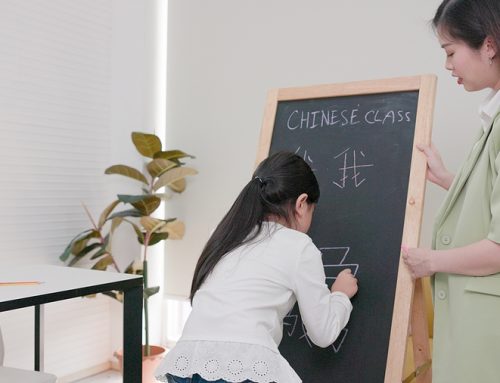
Learning to write and recognise Chinese characters requires attention to stroke order, visual memory, and often, physical technique. Blended learning is particularly well-suited for teaching these basics. In a classroom, teachers can demonstrate proper posture and grip, guide a student’s hand, and physically correct their stroke sequence. This hands-on guidance is especially beneficial for younger learners who are developing fine motor skills and need to learn correct form from the start.
However, once learners are comfortable with basic character formation, fully online learning becomes a powerful tool for practice and retention. Digital apps like Skritter and Pleco gamify stroke order, using spaced repetition systems (SRS) to help students memorise characters efficiently. Learners can review hundreds of characters, track progress, and focus on specific vocabulary sets with immediate feedback. These online tools scale effortlessly, making them ideal for long-term retention and expansion.
In this case, both models bring valuable strengths to the table. Blended learning is best for establishing a strong writing foundation, while fully online learning excels at providing the volume and flexibility necessary for consistent practice and long-term memorisation.
Conversational Practice (口语, kǒuyǔ)
Building spoken fluency in Chinese depends not only on vocabulary and grammar but also on real-time interaction, listening comprehension, and confidence in spontaneous speech. Blended learning supports this well by fostering group conversations in a classroom setting. Students can practice responding to peers, navigating interruptions, interpreting facial expressions and gestures, and experiencing the ebb and flow of natural dialogue. These social cues are often essential in developing a more intuitive feel for the language.
Fully online learning, meanwhile, offers a different but equally valuable opportunity. Platforms like iTalki and HelloTalk connect learners with native speakers across different Chinese-speaking regions. One-on-one conversations via video chat provide extended speaking time and allow learners to dive deeply into personalised topics of interest. Whether you’re preparing for a business meeting or wanting to refine your grammar, these focused sessions offer targeted speaking practice from the comfort of home.
In this domain, the better model depends on your goals. For students aiming to build comfort in group conversations and real-world settings, blended learning offers more dynamic and varied interaction. For those looking for convenience and customisation—especially learners at an intermediate or advanced level—fully online options may provide better speaking outcomes.

Beyond the Language: Crucial Factors to Consider
While effectiveness in language instruction is important, real-world factors such as time, motivation, and access to resources also play a role in choosing the right model.
In terms of flexibility, fully online learning clearly leads. It allows learners to study from anywhere and often at any time. This is invaluable for busy adults juggling work and family or for students with packed school schedules. With no need to travel and the ability to learn on your own terms, online models provide unmatched convenience.
When it comes to motivation and accountability, blended learning often has the advantage. The act of physically attending a class creates a routine that’s harder to break. For children, this consistency is particularly helpful in maintaining focus and discipline. Additionally, in-person classmates create a sense of camaraderie, friendly competition, and social support that many learners find motivating.
In terms of access and resources, fully online learning opens doors that might otherwise remain closed. Students can learn from teachers across China, Taiwan, and Singapore, regardless of their own location. They gain access to vast digital libraries, forums, podcasts, and learning apps—often at a lower cost than traditional courses. This makes online learning a strong contender, particularly for those in areas where high-quality local programs are unavailable.
The Verdict: Making the Right Choice for Your Journey
Choosing between blended and fully online learning depends entirely on who the learner is and what they hope to achieve. Blended learning is often the best fit for young children or absolute beginners who need hands-on support in pronunciation, character writing, and structured conversation. These learners benefit from physical guidance and a classroom routine that helps maintain focus and build foundational skills. If the learner thrives on social interaction, enjoys classroom energy, and has access to a reliable local program, blended learning offers a well-rounded path to fluency.
For families in Singapore looking for such support, Connected Learning offers blended programmes tailored to MOE standards, with small group classes that reinforce both speaking and writing through structured instruction and meaningful interaction. Their approach combines academic rigour with a child-friendly environment that makes learning Chinese both effective and enjoyable.
On the other hand, fully online learning suits intermediate or advanced learners who want to refine specific skills or explore targeted topics like business Chinese or exam preparation. It’s also ideal for teenagers and adults with busy, fluctuating schedules who require flexibility. Self-driven learners who are comfortable with technology and enjoy learning at their own pace will thrive in a fully online model, especially if they live in areas without access to experienced native-speaking teachers.
Conclusion: The Future is a Smart Mix
In the end, the real question isn’t which model is objectively better—but which is better for your unique context, right now. Blended learning delivers structure and foundational strength, while fully online learning offers convenience, scalability, and unprecedented access. As educational technology continues to evolve, the line between the two models may blur.
The smartest strategy may be a mix of both. Even if you choose a fully online course, supplementing it with occasional in-person workshops, immersion trips, or local conversation meetups can provide the social and tactile reinforcement that digital platforms can’t fully replace.
Ultimately, the best learning path is the one that fits your lifestyle and motivates you—or your child—to keep going. Whether you’re just beginning or looking to level up, understanding the strengths of each model empowers you to take charge of your journey to Chinese fluency.