

The ‘In One Ear, Out the Other’ Dilemma
Many parents face an all-too-familiar scenario: your child diligently completes Chinese homework—characters, grammar drills, comprehension passages—but days later, they’re unable to explain the concepts they struggled so hard to learn. It’s the hallmark of passive learning: information absorbed temporarily, yet never truly anchored. More worksheets, rote drills, or exam practice often deepen the frustration without addressing the root problem.
What if the solution didn’t lie in more repetition, but a radical shift in roles—from learner to teacher? That’s the essence of the Protégé Effect, or Learning by Teaching, where explaining material to someone else—even just preparing to do so—profoundly improves comprehension and memory retention. In a language as rich and demanding as Chinese, asking your child to become the teacher can transform exactly how they learn.
This comprehensive guide explores the science behind this powerful learning principle, its specific advantages in mastering Chinese, five easy ways you can use it at home, and how Connected Learning provides support tailored to this approach. By empowering your child to teach, you unlock greater clarity, confidence, and enduring fluency.
The Science Behind ‘Learning by Teaching’
The Protégé Effect is a psychological phenomenon demonstrated across numerous studies: preparing to teach or teaching material leads to dramatically better retention than passive study. Researchers at Stanford, for instance, found that students tasked with teaching a virtual character outperformed their peers who only studied for themselves—even when the actual material was identical. Simply framing the task as teaching triggered deeper mental processing and improved test performance, especially among lower-achieving students.
Effectiviology explains that this method increases metacognitive processing—learners become more conscious of how they learn, organise knowledge more logically, and practise active recall rather than passive familiarisation. The Guardian elaborates further: when we know someone else—and often something we own, like a toy or pet—depends on our understanding, we make a real effort to learn properly. That sense of responsibility shifts learning from routine to accountable mastery.
Moreover, this principle is far from modern; educators have long recognised it. Jean‑Pol Martin in the 1980s formalised Lernen durch Lehren—learning by teaching—which quickly became a method adopted in German schools. Even Seneca posited it centuries ago with “While we teach, we learn”.

Why This Strategy Works Wonders for Learning Chinese
Deepening Character Recognition
Chinese characters often embed meaning within their strokes and radicals. When your child teaches a character like 信—explaining its person (人) and words (言) components—the explanation cements both shape and meaning, turning abstraction into familiarity. This process is far more effective than rote copying, as it forces them to think about the visual structure and semantic significance.
Clarifying Nuanced Vocabulary and Grammar
Chinese words like 安静 (quiet) and 清静 (tranquil), while similar, carry different connotations. Explaining such nuances to someone else compels a child to really understand the subtle differences in tone and context. The same holds with grammar patterns: teaching the usage of connectors like 虽然…但是… (although… but…) requires the child to map out logical relationships, not just rely on imitation.
Transforming Comprehension into Internalisation
Comprehension questions often invite surface recall. But when a child has to teach back a passage—explaining motivations, cause and effect, and underlying themes—they engage in deeper synthesis and narrative reconstruction. This method encodes the material more thoroughly and improves future recall.
Building Resilient Confidence
Explaining a difficult idiom like 对牛弹琴 (speaking to the wrong audience) to you—or even to a toy—gives your child authentic confidence. They experience not just a good grade, but mastery. It’s a realisation of competence and clarity, which enhances self-esteem and readiness for oral exams or classroom participation.
The Parent’s Playbook—Five Ways to Activate the Protégé Effect
Daily “Teach Me One Thing” Ritual
Transform a few minutes each evening—five or ten is all it takes—into a teaching moment. Ask your child to share and explain one new character, idiom, or grammar point they’ve learned. You assume the role of a curious student, which naturally primes them to organise their thoughts and articulate clearly.
Sibling or Toy Teaching Scenario
If there’s a younger sibling around, encouraging your child to teach them characters, pinyin, or simple phrases is powerful. If they’re an only child, a row of toys or even a pet can serve as their “students.” Simply speaking aloud to an audience—even inanimate—propels them into memory-building explanation.
Storytelling Idioms at the Dinner Table
Let idioms come alive through storytelling. When your child learns a new chéng yǔ, ask them to narrate the origin story—its cultural context, historical anecdote. This transforms memorisation into narrative structure, making idioms memorable and meaningful.
Whiteboard Teaching Sessions
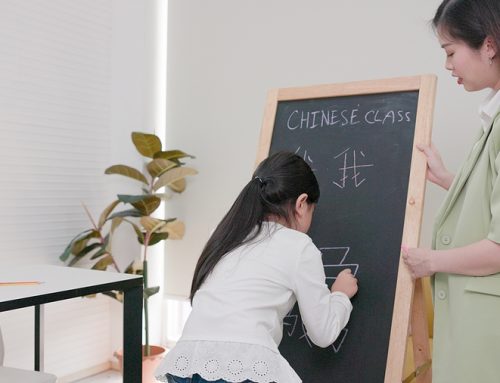
A small whiteboard can make learning dynamic. Present a challenging composition prompt or grammar question and ask your child to explain it from scratch. Writing, drawing connections, teaching as they go—this visual-verbal combination anchors their understanding more securely.
Recording Teaching Videos
Many children enjoy digital creation. Inviting them to make a short video teaching a Chinese concept—even just a minute long—adds purpose and pride to the task. Reviewing the video reinforces learning, and the self-explanation model strengthens clarity and memory.
Being the Ideal “Student”
How you respond as a parent matters. Show genuine curiosity, ask thoughtful open-ended questions (“Can you explain that part differently?”), and praise their teaching effort. Stating “That was so clear!” supports their confidence more than focusing on perfection. And please embrace a bit of affectionate ignorance—your child should feel like the expert in the room. That dynamic empowers ownership and mastery.

Backed by Research—More Than Anecdote
Real-world studies validate the Protégé Effect. The teachable agent study “Betty’s Brain” had students teach a computer agent, resulting in improved learning outcomes, especially for lower-performing individuals. Those students spent more time reading, displayed deeper engagement, and outperformed peers.
GrowthEngineering’s insight underscores how articulating information strengthens memory pathways. Those who explain or prepare to teach consistently outperform peers who rely on repetitive review. These studies consistently show that teaching, or teaching-like preparation, catalyses deeper processing and better learning—powers that traditional revision alone doesn’t harness.
Fit for Singapore’s Education Landscape
Singapore’s bilingual education framework aims not just at fluency, but expressive confidence and cultural grounding. The Speak Chinese Campaign and the broader bilingual policy emphasise building Chinese proficiency embedded in understanding—not just rote learning of characters. Teaching-first techniques echo this ambition, building metalinguistic awareness, precision, and self-assurance in learners.
Connected Learning, a Singapore-based tuition provider, exemplifies this philosophy. Their programmes emphasise interactive, small-group Chinese lessons delivered live by qualified tutors. Lessons include vocabulary, grammar, composition, comprehension, and oral practice, fully aligned with MOE syllabus standards. Their approach encourages students to articulate, explain, and construct language—mirroring the Protégé Effect in a supportive environment. For parents seeking a structured bridge between school learning and teaching-in-practice, Connected Learning’s small class format and pedagogical design are worth exploring.
Enhancing Learning with Memory Techniques
To supercharge the Protégé Effect, incorporate spacing strategies. Research on the spacing effect shows that revisiting lessons at increasing intervals (one day, three days, seven days…). Pairing spaced repetition with teaching means your child will prepare to teach a concept multiple times, each time deeper and more fluent.
Similarly, the enactment effect—learning by doing—shows that performing actions while learning (e.g., writing characters while explaining) boosts memory retention. Combining teaching with physical enactment (writing stroke by stroke) enhances both cognitive and motor memory.
From Passive Learner to Confident Teacher
By embracing the Protégé Effect, you transform your child’s learning experience from passive consumption to active mastery. These methods go beyond improving test scores—they cultivate a deeper connection with the language, sharpen explanatory skills, and build resilient confidence. When your child explains what they’ve learned, they become the expert—and the learning becomes their own.
Start tonight: rather than ask, “What did you learn today?” begin with, “Could you teach me what you learned?” This simple reframing can ignite a powerful, durable transformation in how your child learns Chinese.