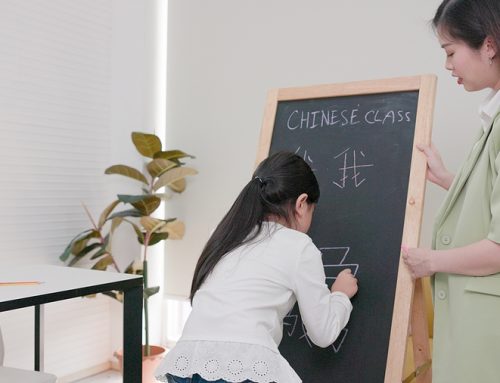


Your child can breeze through their Chinese spelling (听写, tīngxiě), recognise characters in a textbook, and even ace multiple-choice questions on comprehension tests. But when a relative asks them a simple question in Chinese—“你吃饱了吗?”—they freeze, shrug, or immediately answer in English. For many Singaporean parents, this scenario plays out all too often. It’s a puzzling situation: how can a child be doing well in reading and writing, yet struggle to hold a basic conversation? The answer lies in a specific gap—listening comprehension. Not just hearing the words, but truly processing, understanding, and responding to them in real time.
This gap isn’t caused by laziness or a lack of exposure. Rather, it stems from a reliance on passive learning methods that don’t activate the brain’s language processing centres in the same way that real communication does. Interactive listening—where children actively engage with what they hear and respond—is the crucial strategy that transforms a passive learner into an active speaker and thinker in Chinese. And in a system like Singapore’s, where the PSLE oral and listening components carry real weight, interactive listening isn’t just useful—it’s essential.
The Limits of Passive Listening
Many parents already try to incorporate Chinese into their child’s daily life by playing Chinese songs in the car, turning on Chinese cartoons, or streaming audio stories from apps like Ximalaya or the NLB’s Libby. This kind of exposure is known as passive listening. It plays a subtle role in helping children develop a sense of 语感 (yǔgǎn), the intuitive grasp of language rhythm and sound patterns. Over time, it can familiarise children with pronunciation, intonation, and basic sentence structures.
However, passive listening has its limits. When there is no need to respond or pay attention, the brain begins to treat the input like background noise. Much like how we might tune out elevator music or ignore announcements on a train we ride daily, children learn to “hear” without truly processing. This means that even with hours of exposure, they may still struggle to understand when someone speaks to them directly or when they’re required to recall spoken information for a test. For skills like listening comprehension in the PSLE or everyday conversations with family, passive listening alone isn’t enough.

What Exactly Is “Interactive Listening”?
Interactive listening turns the act of listening into a two-way street. It’s not just about hearing, but about engaging—hearing something, processing it, and then formulating a response. That response may be verbal, physical, or written, but it is crucial. Without it, comprehension remains untested and the learning experience incomplete.
For example, one form of interactive listening is responding to simple questions. If you ask your child, “你今天在学校做了什么?” (What did you do at school today?), and they respond with a sentence—even a simple one like “我学了数学” (I learned maths)—they’ve gone through the process of understanding, organising their thoughts, and replying. This cycle strengthens their processing speed and helps them become more fluent in conversation.
Another form of interactive listening is following instructions. If you say, “请把红色的碗拿给我” (Please pass me the red bowl), and your child performs the action correctly, it shows they have understood both vocabulary and sentence structure. Real-world comprehension is reinforced through these small exchanges.
Interactive listening can also involve summarising information. After listening to a short Chinese story, your child could be asked to retell the main idea in their own words. Even a one-sentence summary—“那个小男孩找到了他的狗” (The little boy found his dog)—demonstrates active processing and understanding.
Another powerful technique is predicting outcomes. If you’re watching a cartoon or video together, pause midway and ask, “你觉得接下来会发生什么?” (What do you think will happen next?). This builds inference skills and pushes your child to engage with content rather than passively consume it.
These forms of interaction reinforce comprehension, strengthen vocabulary in context, and begin to close the gap between hearing Chinese and using it meaningfully.
Why This Practice Is Non-Negotiable
Interactive listening is more than an educational trend. It directly addresses the language learning needs that matter most to parents: exam success, conversational fluency, and cognitive development. It trains children to think in Chinese rather than rely on internal translation, setting them up for long-term success in a bilingual world.
It Directly Fuels PSLE Success
One of the most immediate benefits of interactive listening is how well it prepares students for the PSLE’s listening and oral components. In the listening comprehension paper, students must understand spoken passages and answer questions based on them—this includes identifying main ideas, recognising emotional tones, and recalling specific details. This format closely mirrors interactive listening tasks, where children must stay mentally engaged with spoken input and extract relevant meaning.
Even more significantly, the oral exam has evolved. It now features a video-based stimulus, followed by a conversation where the student must respond to questions about the video. These questions often require interpretation and opinion, not just factual recall. A child who is used to interactive listening at home—pausing to predict, summarise, or explain—will be far better equipped to handle these questions with confidence and clarity.
It Builds the Bridge to Confident Speaking
Children often struggle to speak in Chinese not because they lack vocabulary, but because they don’t understand spoken language fast enough to respond. They hear a question, translate it to English in their heads, formulate an answer in English, then attempt to convert that back into Chinese. This roundabout process creates long pauses, uncertainty, and often discourages them from speaking at all.
Interactive listening helps break this cycle. When children get used to processing Chinese in real time, they become more comfortable responding directly in the language. Over time, the internal translation step fades away, and speech becomes more natural. It builds not just language ability, but the confidence to use it spontaneously—a crucial factor in oral exams and daily interactions.
It Develops Faster Cognitive Processing
Like exercising a muscle, the brain becomes faster and more efficient the more it practices a specific skill. Interactive listening trains the brain to process Chinese more quickly and accurately. Instead of labouring over each word, the child begins to recognise phrases, interpret meaning from tone and context, and make educated guesses about unfamiliar vocabulary.
This kind of cognitive agility reduces mental fatigue during tests, speeds up comprehension, and helps children engage with longer or more complex texts. It also boosts their sense of control over the language, which translates into greater motivation to improve.
Practical Ways to Build Interactive Listening at Home
The best part about interactive listening is that it doesn’t require fancy tools or a rigid schedule. It’s easy to integrate into daily routines with a bit of creativity and consistency.
During car rides, for example, you can go beyond just playing Chinese audio stories. Choose a short episode and listen to it together. Then pause and ask questions like, “这个角色是谁?” (Who is this character?) or “他为什么生气?” (Why is he angry?). This simple change transforms car time into active learning time.
At home, screen time can become a powerful learning tool if it’s slightly gamified. While watching a Chinese cartoon or educational show, pause at key moments and ask your child to explain what just happened or predict what might come next. Questions like “你觉得他现在要去哪里?” (Where do you think he’s going now?) keep your child engaged and build narrative understanding.
The kitchen is another excellent environment. As you cook or bake, give simple commands in Chinese like “帮我洗菜” (Help me wash the vegetables) or “拿三个鸡蛋” (Get three eggs). Each instruction your child successfully follows is a confirmation of understanding—and a form of interactive listening that feels like play, not pressure.
You can also involve extended family. Encourage grandparents or Chinese-speaking relatives to send short voice messages. These could be greetings, jokes, or questions. Ask your child to listen and then record a short response. It’s authentic communication, low-pressure, and a wonderful way to build listening skills while maintaining family bonds.
From Passive Hearer to Active Participant
The journey from hearing to understanding doesn’t happen overnight. But with interactive listening as a daily practice, it can happen steadily, naturally, and enjoyably. Passive exposure has its place, but it cannot replace the mental engagement and confidence-building power of active response.
In today’s educational and social landscape, where the stakes of bilingualism are higher than ever, helping your child become an active participant in the Chinese language is not just helpful—it’s critical. It opens the door to success in school, meaningful conversations with family, and access to a wider cultural world.
Parents who want structured support in nurturing these listening skills may consider Connected Learning, where interactive strategies are part of their core Chinese programmes. With a focus on building fluency through engagement, they support children in becoming confident communicators—not just test-takers.
Start today by asking one question, giving one instruction, or pausing one video. Every time you invite a response, you’re strengthening your child’s comprehension, fluency, and connection to the language. Interactive listening is more than a method—it’s a mindset shift, from consuming language to using it. And that’s where real fluency begins.